The Pre-PDF Era: Document Chaos
The Portable Document Format (PDF) has become an indispensable part of our digital lives, but few people know its fascinating origin story. From a small project at Adobe to becoming the global standard for document exchange, the PDF's journey is remarkable. Let's travel back in time and explore how this revolutionary format came to be.
"The goal was to create a universal way to communicate and view printed information electronically, across a wide range of computer systems."
— Dr. John Warnock, Co-founder of Adobe (on Project Camelot)
Before PDF, sharing documents was a nightmare. Imagine creating a beautiful document on your computer, emailing it to a colleague, and watching as fonts changed, images shifted, and layouts completely broke. This was the daily reality in the early 1990s.
The problem was simple: different computers had different fonts installed, different operating systems rendered text differently, and there was no standard way to preserve formatting across devices. What looked perfect on your Mac would look completely broken on a Windows PC.
The "Tower of Babel" Problem
Tech experts called this the "digital Tower of Babel" - every system spoke its own language, and documents got lost in translation. Something needed to change.

The Birth of PDF: Project Camelot
In 1991, Adobe Systems co-founder Dr. John Warnock had a vision. He wrote a white paper called "The Camelot Project" that outlined a revolutionary idea: a universal document format that would preserve formatting exactly as intended, regardless of the device or software used to view it.
The name "Camelot" was chosen carefully - it represented the ideal of a perfect system where documents could be shared seamlessly, just like the legendary King Arthur's court represented the ideal kingdom.
Key Goals of Project Camelot
- Device Independence: Documents should look the same on any screen or printer
- Font Embedding: Include fonts directly in the document so they never get substituted
- WYSIWYG: What You See Is What You Get - the screen display matches the printed output
- Compression: Efficient storage without compromising quality
- Self-Contained: All elements (text, images, graphics) in a single file
📜 Historical Note
The original Camelot white paper was only 7 pages long, but it changed the course of digital document history forever.
The First PDF Release (1993)
After two years of development, Adobe officially released the first version of PDF at the Windows and OS/2 Conference in January 1993. The response was mixed - many people didn't understand why they needed yet another file format.
The first PDF specification (PDF 1.0) included:
- Basic text and image support
- Font embedding capabilities
- Vector graphics support
- Device-independent color spaces
However, adoption was slow because the tools to create and view PDFs were expensive. Adobe charged for both Acrobat (creator) and Acrobat Reader (viewer).
Acrobat Reader Goes Free (1994)
The turning point came in 1994 when Adobe made a brilliant business decision: they started giving away Acrobat Reader for free. This was revolutionary at the time - giving away software for free was almost unheard of.
The strategy worked perfectly. By making the reader free, Adobe ensured that anyone could view PDF documents. As more people could view PDFs, more organizations wanted to create them. This network effect caused PDF adoption to skyrocket.
💡 Business Lesson
Adobe's "give away the reader, charge for the writer" strategy became a classic business model that many companies still use today.
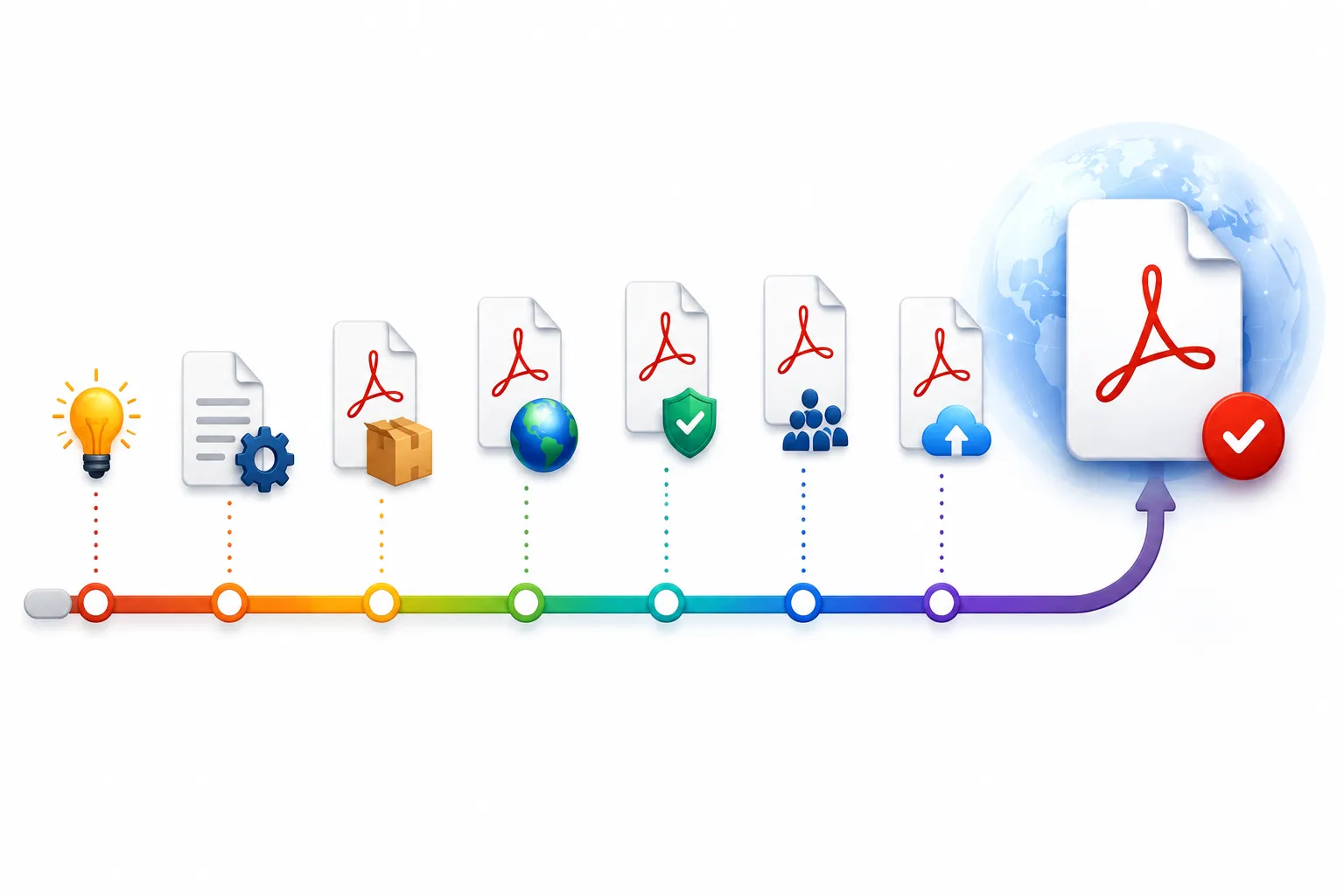
PDF Evolution Timeline: 1993-2024
PDF Becomes an Open Standard (2008)
The biggest milestone in PDF history came on July 1, 2008. On this day, Adobe released the full PDF specification as an open standard published by the International Organization for Standardization (ISO) as ISO 32000-1.
This was a revolutionary move. Adobe essentially gave up control of PDF to ensure its long-term survival. By making PDF an open standard, they guaranteed that:
- Anyone could create PDF-compatible software without paying royalties
- The format would be preserved for future generations
- Governments could confidently adopt PDF for official documents
- Competition would drive innovation in PDF tools
🏆 ISO Certification
PDF is now ISO 32000, making it one of the few document formats with official international standard status.
PDF Variants: PDF/A, PDF/X, PDF/E
As PDF evolved, specialized variants emerged for specific industries:
PDF/A (Archiving)
Designed for long-term preservation. Ensures documents remain readable for decades. Used by libraries, governments, and archives worldwide.
PDF/X (Printing)
For professional printing. Ensures colors and fonts print correctly. Standard in the publishing and printing industry.
PDF/E (Engineering)
Supports 3D models and technical specifications. Used by engineers and architects for CAD drawings.
The Impact of PDF on Business & Society
PDF fundamentally changed how we share information. Here's how:
- Paperless Offices: PDFs allowed companies to significantly reduce paper usage, saving millions of trees annually
- E-Government: Governments worldwide adopted PDF for official forms, tax returns, and legal documents
- E-Books: Many digital books and academic papers are distributed as PDFs
- Legal Documents: Courts accept PDFs as official evidence with digital signatures
- Global Collaboration: Teams across continents can share documents that look identical
- Accessibility: PDFs support screen readers and other assistive technologies
- Digital Signatures: Legally binding electronic signatures transformed business workflows
📊 PDF by the Numbers
The Future of PDF: What's Next?
PDF continues to evolve with modern technology. Here's what's coming:
AI-Powered PDFs
Artificial intelligence will automatically summarize, translate, and extract key information from PDFs.
Cloud Integration
Seamless collaboration with real-time commenting and version tracking across devices.
Blockchain Verification
Tamper-proof document verification using blockchain technology for authenticity.
Enhanced Accessibility
Better screen reader support, voice navigation, and AI-powered alt text generation.
Conclusion: The Legacy of PDF
From a small project code-named Camelot to becoming the world's most trusted document format, PDF's journey is remarkable. It solved a fundamental problem - ensuring documents look the same everywhere - and in doing so, transformed how we work, share, and communicate.
Key takeaways from PDF's history:
- Great innovations often solve simple, everyday problems
- Making a product free can accelerate adoption dramatically
- Open standards ensure long-term survival and growth
- Adaptation to new technologies keeps formats relevant
📄 Experience PDF Power Today
Now that you know the rich history of PDF, put that knowledge to use!
Merge PDFs Like a Pro →
The PDF format continues to evolve. What started as Project Camelot in 1991 now powers document sharing for billions of people worldwide.